

The Silent Smile
Or: how the cheapest word in retail - "sorry" - quietly went out of stock.

It is a Wednesday afternoon.
Somewhere in India, right now, a customer has just walked into a store, found what she was looking for, asked a polite question and received, in reply, the most modern customer service experience this country has invented in the last decade:
A nod.
Not a yes. Not a no. Not even a smile.
A nod.
She tries again. “Hi, this one is for 12x12 hall, or smaller?”
The reply comes back, faster this time, more efficient, more aerodynamic:
“Hmm.”
She stands there for a moment. She is processing. She is unsure whether she has been served, ignored, or quietly judged. The salesperson, meanwhile, has already returned to a phone screen displaying something far more interesting than her possibly an Instagram reel, possibly a WhatsApp conversation with a friend, possibly a YouTube short or even a office meeting.
She has been processed.
She has not been served.
And somewhere on the other side of the city, a senior retail leader is staring at his quarterly customer satisfaction score wondering why it has dropped 11 points and what the hell happened.
I will tell you what happened.
I have walked through approximately 1000 retail stores in the past 18 months.
Possibly more.
What I have observed is not anecdotal. It is systemic. And as a consultant, not as a grumpy uncle, but as someone who has built and managed retail teams for three decades, I am here to name it clearly.
The single cheapest word in retail, ‘sorry’ has quietly gone out of stock.
So has thank you.
So has please come again.
So has, in many stores, the basic eye contact that every retail SOP from 1995 to 2015 considered non-negotiable.
This is not a generation problem. Let me say that clearly so we don’t fall into the easy trap.
This is a system problem. And the system has multiple authors.
The Five Reasons Service Quietly Died (And Nobody Held a Funeral)
Reason 1: The talent pipeline collapsed. Frontline retail jobs used to be aspirational for first-time job seekers. “I work in a store” meant something. Today, that same young person has 14 other options gig work, food delivery, content creation, online tutoring, freelance Instagram management for their cousin’s bakery. Retail competes with all of them. Retail loses. The candidates who actually walk into a store interview are often the ones who couldn’t get into the other options. We are recruiting from the third preference pool. And then we are surprised when the service shows.
Reason 2: Training is now a luxury. Once upon a time, a new recruit would shadow a senior for two weeks before being allowed to face a customer. There were role plays. There were product knowledge tests. There was a small ceremony when you graduated to handling the cash counter. Now, the average new joiner gets a 90-minute orientation, a uniform, and a name badge. By Tuesday, they are alone in an aisle facing an aunty with a price-tag complaint. They have not been taught how to say sorry. Nobody has shown them the difference between acknowledging a customer and processing one. They are not bad at the job. They have not been taught the job.
Reason 3: Attendance is now the KPI. Quietly, across the industry, the expectation for frontline staff has dropped from “deliver service” to “please show up.” When the talent pool is shallow and the attrition rate is 60% and above, managers stop measuring smiles and start measuring whether the person is physically present. If they came in today, that is already a small win. Tomorrow we’ll worry about whether they smiled.
Reason 4: The store manager is also exhausted. The store manager who is supposed to set the tone is herself working 11-hour shifts, managing three vacancies, handling vendor calls, dealing with a regional manager who calls 17 times a day, and is half a quarter behind on her own targets. She does not have the bandwidth to also be the culture coach for a new team member who has decided eye contact is optional. She has bigger fires. The smile training falls to the bottom of her list. Permanently.
Reason 5: Customers themselves changed. Let me be honest. The customer is not always the wronged party. Some customers walk in already irritated, already condescending, already speaking to staff in a tone they would not use with their building security guard. The new staff member has noticed this. She has decided, not unreasonably that if respect is not extended, respect will not be returned. The result is a cold war at the counter. Both sides waiting for the other to be human first. Neither side blinking.
This last reason is the most uncomfortable. Most of us do not want to talk about it. But it is real.
So what do we do?
This is the consultant section. If you have read this far, I owe you actual answers, not just observation.
Five things retail leaders can actually do, starting Monday:
1. Reinstate the 30-minute morning huddle. Not for targets. Not for new offers. For tone. Five minutes of acknowledgement. “Today we will smile at the first customer of every hour. We will say sorry once before lunch even if we have nothing to be sorry for.” Sounds silly. Works.
2. Build a “Customer Acknowledgement Card.” A single laminated card. Three lines. Greet within 5 seconds. Acknowledge the question within 10. Apologise once if you don’t know the answer. Give it to every new joiner on Day 1. Quiz them on it on Day 3. This is not patronising. This is teaching.
3. Mystery shopping, but kindly. Not punitive mystery shopping. Coaching mystery shopping. The shopper visits, observes, then sits with the staff member and shares feedback warmly. Once a quarter. Not as a threat. As a gift.
4. Reward the smile, not just the sale. Most incentive systems reward conversion. Almost none reward how the customer felt walking out. Add it. Even a small monthly recognition. “This month’s most-acknowledged executive.” You will be amazed how fast behaviour shifts when behaviour is measured.
5. Speak to your young staff like adults. This is the most important one.This generation is not allergic to service. They are allergic to being patronised. If you explain why a smile matters that the customer in front of them might be having the worst week of their life, that the store is sometimes the only place they feel seen most young employees respond. Not all. Most. The ones who don’t, eventually leave. The ones who do, become the next generation of retail leaders.
There is one final truth I want to share, and then I will let you scroll down to the strip.
The Indian retail customer is one of the most patient customers in the world.
She will wait. She will inspect. She will compare. She will complain. But she will also return.
She returns to stores that remember her face. She returns to staff who smile. She returns to managers who apologise for things that were not their fault. She returns because in a country where her time, her money, and her attention are pulled at by 4,000 brands every day acknowledgement is the rarest, most valuable currency we have.
When we lose the smile, we are not losing politeness.
We are losing retention.
And retention is the only number that ever mattered.
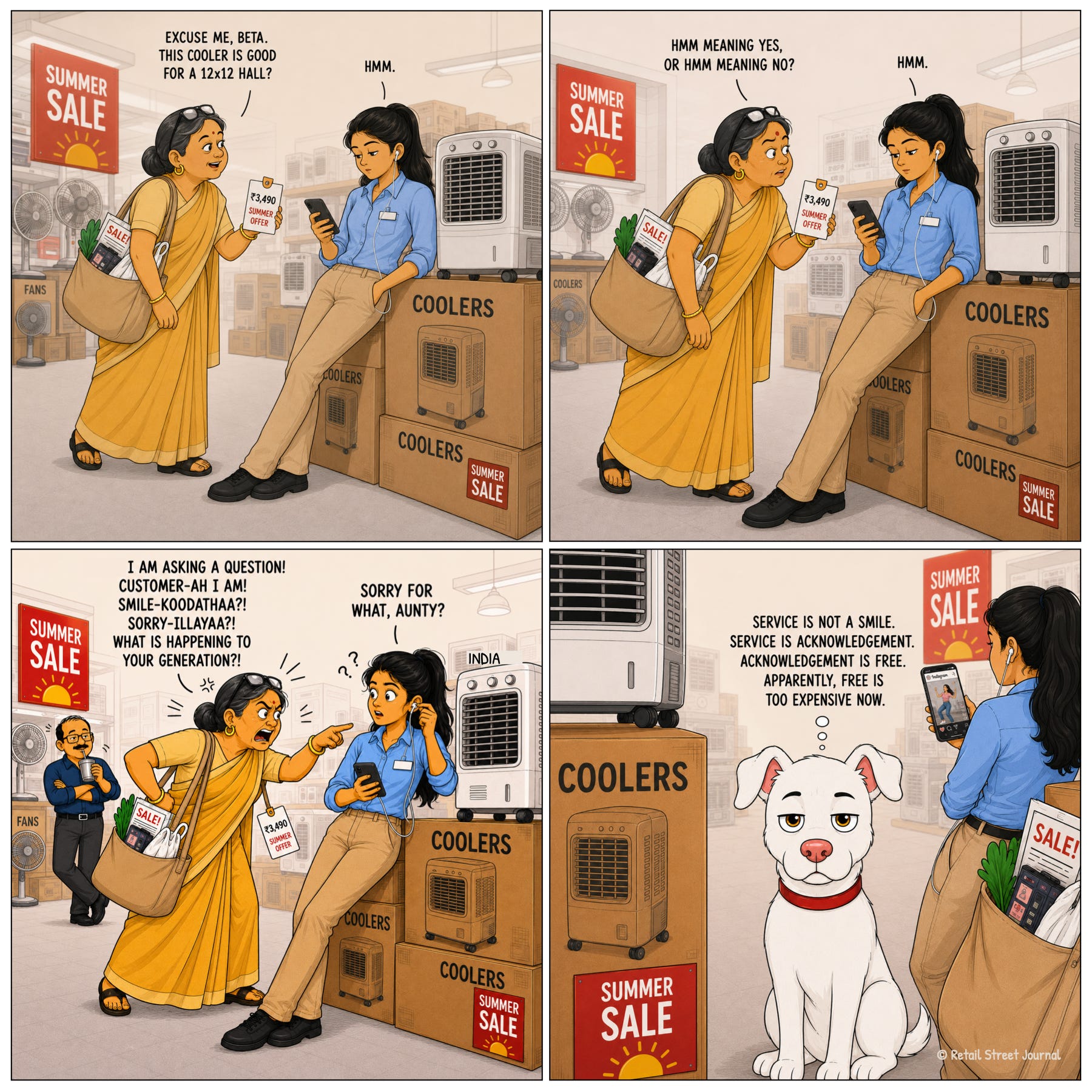
Note: I am not writing this to lecture new team member. I have worked with brilliant new retail teams. I have also worked with rude staff from every generation that came before. The youngest generation is not the problem. The system that hires them, fails to train them, exhausts their managers, and then blames them that is the problem.
Also: the “Hmm” in this strip is taken verbatim from an actual store visit I made last month. The product was a 1.5 ton split AC. The customer was a 60-year-old woman who left without buying. The salesperson did not look up. I followed the customer out of the store. She told me she would buy from the shop next door. The shop next door had less stock, higher prices, and a salesperson who said “Auntyji, please sit, water?” That is the entire competition. That is the entire industry. That is the entire problem.
If you run a store, a region, a brand, or a chain, re-read the five things above. Pick one. Just one. Start Monday.
The customer is still walking in.
The question is whether she walks out feeling seen.
Strip 07 lands Monday. The vendor meeting. Where every promise is final, until it isn’t.
Bring tea. Bring buttermilk. Bring patience.