

The Loyalty Card Trap
Or: how Indian retail invented a program nobody understands and everybody plays.

It is a Tuesday afternoon.
Which means somewhere in India, right now, at a billing counter that has not been cleaned since the morning rush, a customer is holding three loyalty cards, one folded printout, and a screenshot of an SMS from 2023.
She has come, specifically, to redeem her points.
The points are expiring.
The points are always expiring.
This is the natural condition of Indian retail loyalty points, they exist in a permanent state of near-expiry, like dairy products with optimistic best-before dates.
The customer knows the rules.
She knows them better than the store does.
She knows them better than the manager.
She knows them better than the brand’s own marketing team.
The young employee behind the counter does not know the rules. He joined six months ago. The training program did not cover the loyalty program. The training program covered nothing, really, except how to operate the billing system, which is currently offline. He is staring at the customer the way one stares at a passing storm without comprehension, without escape, without joy.
She is now reading from the printout.
She is quoting clause 4.2.
She is correct.
The next 17 minutes of his life will not go well.
I have, in my career, designed loyalty programs.
I have also redeemed loyalty points, as a customer, with the same fury as the woman at the counter above.
This gives me a rare position, I have been on both sides of the loyalty card trap, and I can tell you with full confidence:
Almost every loyalty program in Indian retail is broken.
They are broken in different ways.
Some are too complex. Some are too generous. Some have rules that contradict each other. Some have terms and conditions that the company itself does not know are still active. I have personally seen a 2019 SMS being used as evidence against a 2026 policy update and the customer winning the argument because the company could not prove the policy update had been communicated to her individually.
The customer was correct.
The store gave her the discount.
The marketing team that drafted the 2019 SMS is no longer with the company.
The 2026 policy lives on a PDF nobody has read.
Welcome to the loyalty program lie.
The Six Universal Loyalty Program Sins
Allow me, as someone who has reviewed dozens of these programs over three decades, to enumerate them clearly.
1. Nobody has read the full terms.
Not the customer. Not the staff. Not the manager. Not, in some cases, the marketing team that wrote them. The terms are stored on a webpage that is two clicks deep on a website nobody visits. The PDF version has been updated four times. None of the updates have been broadcast. The original SMS still circulates, occasionally, like a friendly ghost.
2. The expiry rules are made up.
“Points expire in 24 months.” Sometimes 12. Sometimes 18. Sometimes “rolling 24 months from last transaction,” which nobody can compute because the system itself rounds dates. I have seen three customers, in the same store, on the same day, with three different expiry dates for points earned in the same calendar quarter. None of them is wrong. None of them is right. The expiry is cultural, not mathematical.
3. The redemption ratio is hidden.
“100 points = ₹1.” Or sometimes ₹2. Or sometimes ₹0.50 depending on the day, the product category, the store format, or whether the moon is in Capricorn. Most customers do not know the ratio. Most stores do not advertise it. When asked, the staff member will typically reply “Aunty, system will calculate.” The system is, in fact, also confused.
4. The minimum threshold is a trap.
“Redeem your points only on bills above ₹2,000.” The customer has ₹247 worth of points. She has come to the store specifically to redeem them. She is now being told she must spend more money to use the points she has already earned. She is, understandably, enraged. She will spend the additional ₹1,750 — but she will tell three friends what happened. The points became negative marketing.
5. The exclusion list is the actual product line.
“Loyalty points cannot be redeemed on electronics, appliances, white goods, festival offers, sale items, or seasonal promotions.” These are, of course, the only things anybody buys. The points can be redeemed on the one product line nobody wanted in the first place, the slow-moving inventory that the loyalty program is being used to liquidate. The customer figures this out quickly. She is not flattered.
6. The loyalty program is not actually about loyalty.
Most retail loyalty programs are not designed to reward loyalty. They are designed to capture customer data. The points are the bait. The customer’s mobile number is the prize. After 18 months, the company has collected millions of phone numbers and built almost no actual loyalty. The customer’s true loyalty was never to the program. It was to the nearest store with parking. The two are different.
Now — let me say something that the loyalty program industry will not like.
The smartest customer in your store has cracked your program.
She has figured out which day the bonus points trigger. She has learned that buying during the first week of the month earns 1.5x. She has noticed that the system glitches around midnight on the 28th and quietly adds extra points. She has, in some cases, taught other customers how to maximise the program.
You did not design the program for her. But she has redesigned it for herself.
This is not fraud. This is brilliance.
The customer who beats your loyalty program is also, statistically, your most valuable customer. She shops more. She spends more. She returns more often. She is also the one who will quote clause 4.2 at your trainee on a Tuesday afternoon.
You can either get angry at her, or you can study her.
The smart retailers study her.
So what does a good loyalty program look like?
Four things. Brief. Real.
1. Simplicity is the new luxury.
The best loyalty programs of the next decade will be one-line programs. “Every ₹100 spent = ₹2 credit, redeemable anytime, on anything, never expiring.” That is the entire program. No tiers. No exclusions. No clauses. Customers will worship simplicity. Staff will finally be able to explain it. The brand will finally be trusted.
2. Make redemption frictionless.
The customer should not have to ask for redemption. The system should prompt the customer at checkout. “You have ₹247 in loyalty credit. Apply now?” One tap. Done. Most retailers make redemption feel like applying for a passport. This is not loyalty. This is resistance training.
3. Tell the customer her points balance every month, unprompted.
Not as part of a 14-point promotional newsletter. As a single SMS or WhatsApp message. “Hi Lakshmi, you have ₹312 in store credit. Use it whenever you visit.” This single message, sent consistently, builds more brand affection than any banner ad. It costs almost nothing. Yet 90% of retailers do not send it.
4. Reward behaviour, not just spend.
The future of loyalty is not just “buy more, get more.” It is “come back more, get more.” Reward the visit, not just the bill. The customer who walks in 12 times a year is more valuable than the customer who walks in twice and spends double, because the 12-visit customer becomes a habit. Habits are the only loyalty that survive recession, festival fatigue, and online discounts.
There is one more truth.
A loyalty program is not a marketing tool.
It is a promise.
The customer who joins your program is trusting you with two things, her phone number, and the assumption that you will treat her better than you treat strangers. When you violate either, you have not just lost a customer. You have trained the next generation of customers to be cynical about every loyalty program that follows.
The customers you respected through your loyalty program will defend your brand. The customers you betrayed through hidden clauses and expired points will tell their daughters, “Don’t sign up for that one. They cheat on points.”
That sentence, passed from mother to daughter is more powerful than any quarterly campaign.
This is what loyalty really is.
It is not points.
It is not even the program.
It is whether, after 17 minutes of arguing at a billing counter on a Tuesday afternoon, your customer leaves the store still wanting to come back.
If she does, your program worked.
If she doesn’t, no expiry rule will save you.
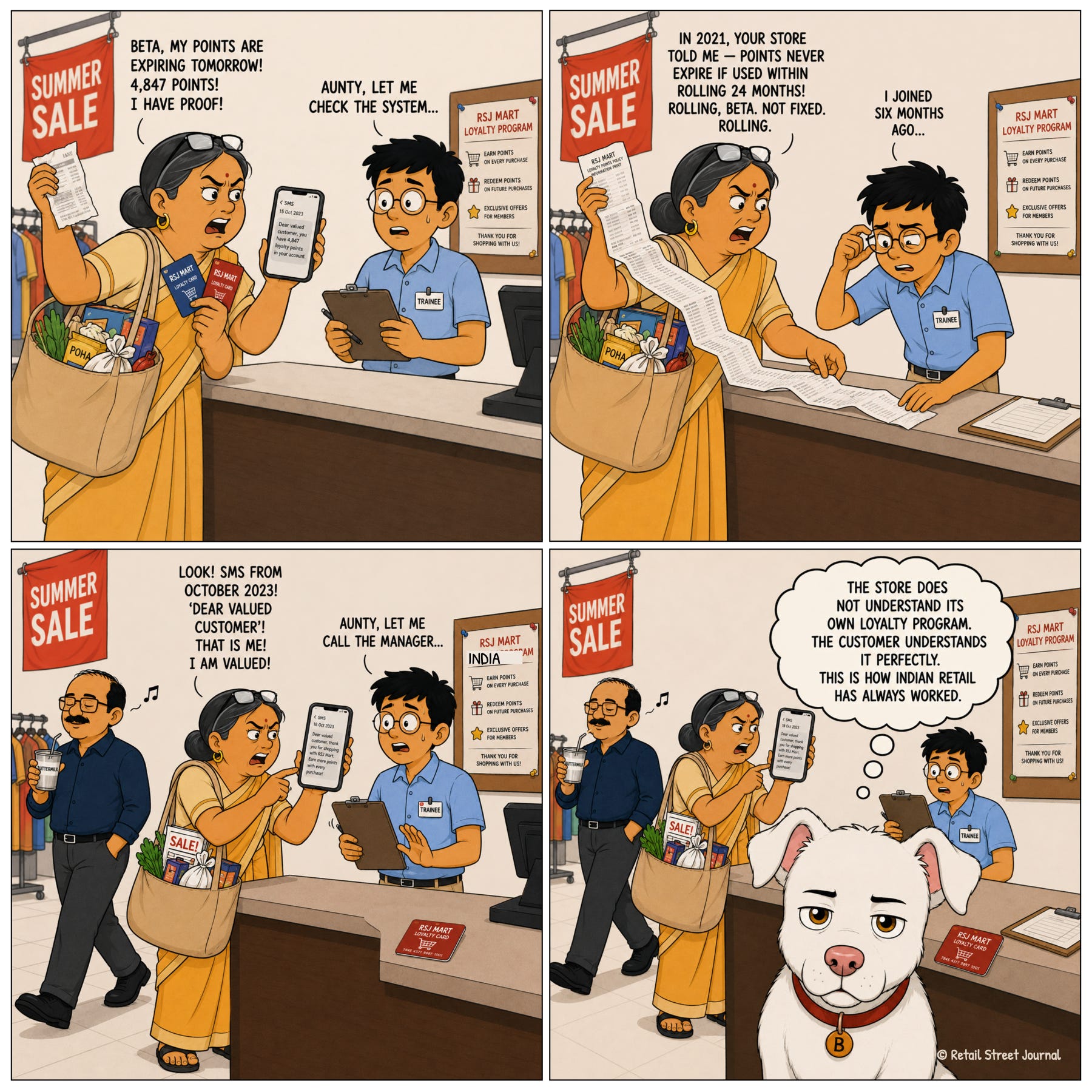
Note: The clause 4.2 reference is real. I will not specify the company. I will say that I was once present in a store when a customer correctly quoted a clause that the regional head had not read since the program was launched in 2018. The regional head paid the redemption. He also, quietly, requested a copy of the terms from his own marketing team. They could not find it.
Also: the “Aunty, system will calculate” line is the most-spoken sentence in Indian retail loyalty programs since 2015. I have heard it in Hindi, Tamil, Telugu, Kannada, Bengali, and Marathi. It is a national catchphrase. It also means nothing. The system has not calculated anything. The staff member is buying time. The customer knows. Everyone knows. The phrase continues anyway.
If you run a loyalty program for any retail business, large, small, online, offline, do this one thing today. Pull out your own terms and conditions. Read them. All of them. Out loud. If you cannot get through clause 4.2 without sighing, your customer is going to win at the counter.
The customer always knows the rules. The question is whether you do.
Next strips lands Monday. The billing counter. The system is slow. The queue is long. Time is broken.
Bring tea. Bring buttermilk. Bring patience.