

The Group That Never Sleeps
Or: how Indian retail discovered that night, in fact, is just another working hour.

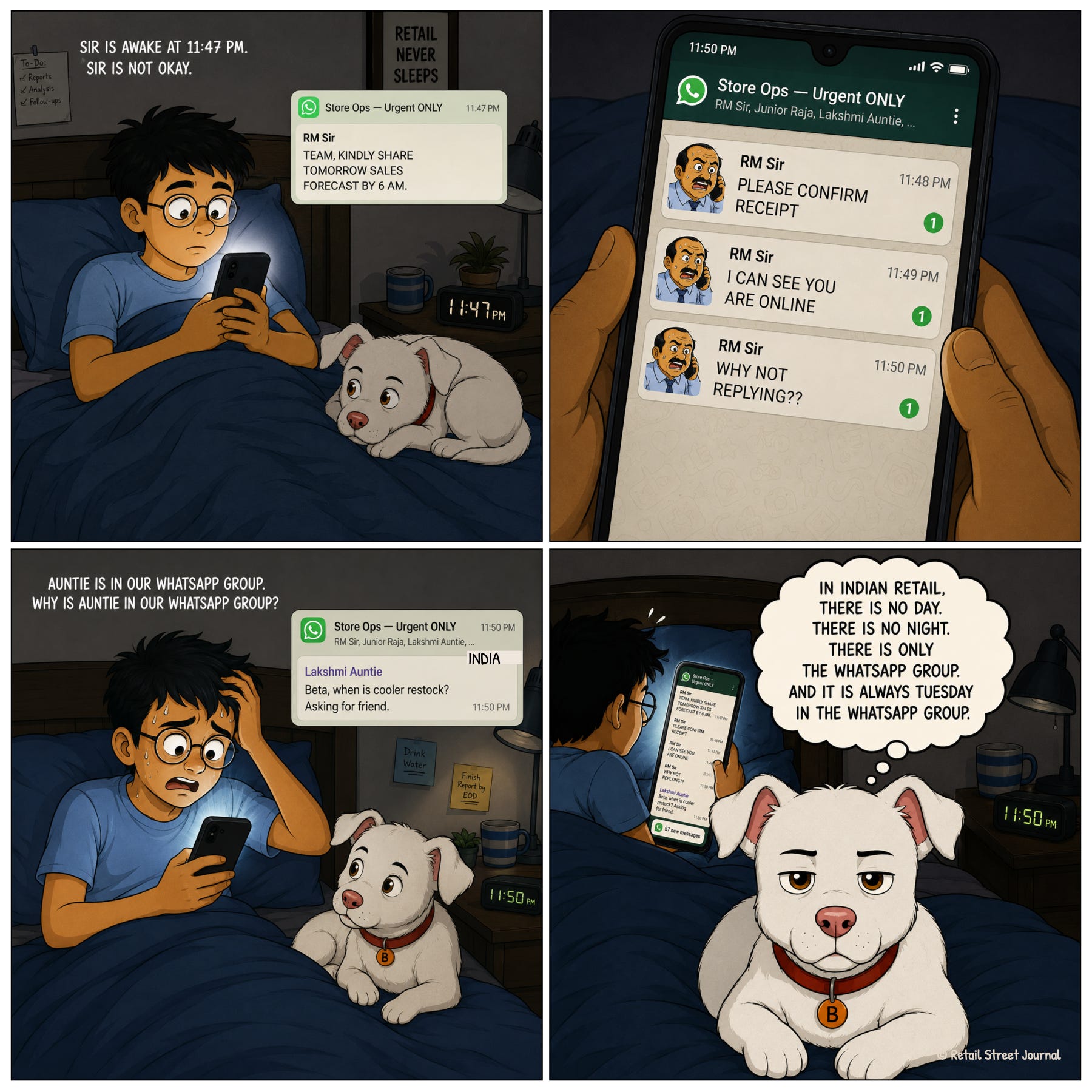
It is 11:47 PM.
Which means somewhere in India, right now, in a bedroom with an AC running on Sleep Mode, a retail employee is in bed, blanket pulled up, eyes half-closed and his phone has just lit up his face like a small, hostile sun.
It is a WhatsApp notification.
It is from a group named “Store Ops - Urgent ONLY.”
The group has 47 members.
The “Urgent ONLY” is the most ironic phrase in the history of corporate India.
The message is from a senior. The message is in capital letters. The message contains the words “KINDLY SHARE”, a phrase that, in Indian corporate WhatsApp culture, has been weaponised so completely that it now translates to “do this immediately or face consequences I will not specify in writing.”
He stares at the message.
He has a choice.
He can pretend not to have seen it.
But the blue tick has already betrayed him. He is, in fact, online. The senior knows. The senior is also still awake. The senior is now waiting for confirmation. The next message will arrive in approximately 90 seconds. It will say:
“PLEASE CONFIRM RECEIPT.”
The capital letters are not a typo. They are the new tone of voice for Indian middle management after dark.
Welcome to the group that never sleeps.
Welcome to Tuesday.
It is always Tuesday in the WhatsApp group.
I have been a member of approximately 240 retail WhatsApp groups in my career.
Possibly more.
Some of them I joined willingly. Some of them I was added without consent by a person I once exchanged business cards with at a 2014 conference. Several of them are still active. None of them have been muted, because muting is considered a political act in Indian corporate culture, a quiet declaration that you do not, in fact, find this group urgent.
The most disturbing group I am still part of has 312 members. It was created in 2019 to coordinate a single store opening. The store opened. The store has since closed. The group is still active. Last week someone posted “Good Morning” with a sunrise GIF. 47 people responded with namaskaram emojis. Nobody has asked why the group still exists. Asking would be impolite. The group has a life now, independent of its purpose.
This is not a WhatsApp problem.
This is a culture problem.
WhatsApp is just the vehicle.
The Seven Stages of Indian Corporate WhatsApp
Allow me to walk you through the lifecycle of a retail WhatsApp group, as I have observed it across three decades.
Stage 1 - The Creation.
A senior manager decides that email is “too slow” and creates a WhatsApp group for “quick coordination only.” The group has 8 members. There is genuine optimism. Everyone agrees this will be efficient.
Stage 2 - The Mission Creep.
The group expands to 23 members. The original purpose is now unclear. People are being added “to keep them in the loop.” Nobody is leaving. The senior manager is pleased, communication is “flowing.”
Stage 3 - The Good Morning Era.
Somebody starts posting “Good Morning” with flower emojis at 6:30 AM. Three others reply. By the end of week one, this is now a daily ritual. Replying is mandatory. Not replying is interpreted.
Stage 4 - The After-Hours Migration.
The first 10 PM message appears. It is a “small clarification.” The clarification could have waited until morning. It did not wait. The senior who sent it is now reading replies in bed. He considers this a sign of “team commitment.”
Stage 5 - The “Please Confirm Receipt” Phase.
This is when the group officially crosses into chaos. A senior sends an instruction. He then sends “please confirm receipt.” People begin replying with single words, “noted”, “received”, “ok sir”. The thumbs-up reaction is invented for this exact purpose. It is not enough. People still type the word “NOTED.” Often in all caps. Often at 11 PM.
Allow me a brief personal aside, because this story explains the entire problem.
Years ago, in a previous company, a senior posted a long message in our team WhatsApp group. It was structured like a methodology document — recommendations, working principles, philosophical asides, at least one metaphor involving cricket. Possibly two. The full thing ran longer than a printed page.
I read it. Carefully. Twice.
Then I typed: “Noted.”
The next day, the senior caught me in person. He was, visibly, hurt.
“I wrote more than a page,” he said, “and you just typed ‘noted’? What is this?”
I had a choice. I could have explained that “noted” is, in fact, the most accurate possible response to a message that contains no decisions, no deadlines, and no actionable items. I could have explained that length is not the same as substance. I could have explained that responding with equal length would have required me to also produce a page of philosophical content, which I did not have, because I was busy doing the actual job he had not described.
Instead, I said: “Noted, sir.”
He looked at me. I looked at him. He walked away.
The group continued.
That was the day I learned a truth no SOP manual will ever capture:
The sender of a long message is not always asking for a response. He is sometimes asking for an audience.
Stage 6 - The Saturation Point.
The group is now generating 200+ messages a day. Most are forwards. Many are unrelated to retail. Someone has posted a wedding invitation. Someone else has posted a real estate scheme. Three people have posted election content. The original eight founders are still in there, no longer reading any of it, but unable to leave.
Stage 7 - The Permanent State.
Nobody can shut it down. Nobody can mute it without political consequence. Nobody can ignore it. New members are still being added. The group will, in all likelihood, outlive everyone in it. It is now a digital ghost, a structure that exists for no reason and refuses to die.
The group, like the office it replaced, has become the company.
Now — let me be a consultant for a moment.
This is not just an inconvenience. This is a real business problem. Here is why.
1. There is no off-switch.
A junior employee who used to leave the office at 7 PM is now on call until 11 PM. He is not paid for this. He is not officially expected to respond. But he is unofficially expected to respond. Otherwise, by Friday, his manager will say “You don’t seem fully engaged.” The capital letters are not formal. But the consequences are.
2. Decisions are getting made in chaos.
Major operational calls, pricing, stock, promotions, escalations are now being made in scrolling threads between 9 PM and midnight. There is no record. There is no decision log. There is no follow-up. By Tuesday afternoon, three different people will have three different memories of what was decided. WhatsApp is great for chatter. WhatsApp is terrible for decision-making. We are using it for both.
3. The juniors are burning out silently.
Senior leaders genuinely do not understand this, because they grew up in a culture where being “reachable” was a virtue. The junior employee today views constant reachability as a form of disrespect. He is right. But he will not say so. He will quietly start looking for jobs. The attrition number you cannot explain in your HR review meeting, it lives inside the WhatsApp group.
4. The boundary has been outsourced to the wrong people.
The senior manager sending messages at 11 PM is not a villain. He is exhausted himself. He has been told his response time matters. He is reacting to his own WhatsApp group, two levels above. The 11 PM message is being relayed downward, from his head office group to his RM group to his store group like a chain letter of stress. By the time it reaches the cashier on the night shift, the original message is unrecognisable. But the urgency has survived.
So what does a healthy retail WhatsApp culture actually look like?
Four things. Brief. Real.
1. Define “after-hours” in writing.
Most retail companies have never explicitly said when WhatsApp work stops. The absence of a rule is the rule. Senior leadership should write one. “No operational WhatsApp messages between 9 PM and 8 AM, except genuine emergencies.” The word “genuine” needs definition. A store that is on fire is genuine. A request for tomorrow’s forecast is not.
2. Move decisions out of WhatsApp.
WhatsApp is for coordination. Email is for decisions. Documents are for commitments. If a major operational call is happening in a chat thread at 10 PM, somebody senior should say “please put this in an email tomorrow morning and we will discuss.” This single sentence, used consistently, saves entire teams from chaos.
3. Audit your groups quarterly.
Most of your WhatsApp groups serve no purpose. They were created for projects that have ended. The members do not know why they are still in there. Run an audit. Close the dead groups. Reduce the active ones. Your team will visibly relax in the first week.
4. Model the behaviour from the top.
If the CEO sends a message at 11 PM, the entire company gets the signal: 11 PM is now a working hour. If the CEO drafts the message at 11 PM but schedules it for 9 AM the next morning, the entire company gets the opposite signal. Both messages cost the same. Only one of them is leadership.
There is one more truth.
The biggest contributor to retail attrition in 2026 is not salary. It is not commute. It is not even the manager personality.
It is the quiet erosion of evenings.
People do not quit their jobs.
They quit the slow realisation that there is no longer a moment in the day when the phone will not light up.
The retail industry built itself on long hours and personal sacrifice. That model is dying. The next generation is not refusing hard work. They are refusing invisible hard work — the work that has no name, no compensation, and no end.
If you run a retail business in 2026 and your attrition is rising, look at your WhatsApp groups before you look at your salary slabs.
The answer is probably blinking on someone’s phone at 11:47 PM right now.
Note: The 312-member ghost group is real. It still exists. I am still in it. Someone posted “Good Morning” this past Tuesday. I am not going to leave the group. Leaving would create more drama than staying. This is how every Indian corporate WhatsApp group eventually becomes immortal.
If you are reading this on your phone at 11:47 PM because someone in your group just sent “PLEASE CONFIRM RECEIPT” close the app. Reply tomorrow. The world will not end. The group will not shut down. It will, in fact, still be there in the morning, possibly with a new “Good Morning” sunrise GIF.
Strip 09 lands Thursday. Till then
Bring tea. Bring buttermilk. Bring patience.