

The Forecast
Or: how Indian retail learned to predict the future using vibes and a stained coffee mug.

It is May.
Somewhere in India, right now, on a retail floor with three working tube lights and one dying AC, a regional manager is on a phone sweating into the receiver, and he is saying, with full chest, full lungs, full delusion:
“Sir, I am very confident sales will cross last year by 30%.”
Confident.
CONFIDENT.
Sir, please. Open a dictionary. Just once. Confident is not a personality trait you can deploy in place of checking the file.
Has he looked at last year’s data? No.
Has he looked at this year’s data? Also no.
Has he opened the inventory report? The report opened itself two weeks ago and is now sitting in his inbox like an unloved child.
Has he checked the weather? My friend, in May, the weather IS the data.
But he is not deterred. He is never deterred. Because last quarter he said 25% and got yelled at by his own boss in front of three trainees and a vending machine. So this time he is saying 30%. Next time he will say 35%. By Diwali he will say 200% and pass out from his own ambition.
He has discovered the magic formula:
Confidence is cheaper than forecasting, and it travels faster in WhatsApp groups.
I have sat in roughly 1,000 of these meetings.
Possibly 1,200.
I lost count somewhere around the time a strategy head — in a striped shirt, full of vada and ideas — stood up and announced:
“This year, we must aim for 100% growth. And 200% is out aspirational stretch goal.”
The room nodded.
THE ROOM NODDED.
I looked around. Every single person was nodding. Like he had said something normal. Like he had ordered tea. Nobody asked 200% of what? Nobody asked based on which planet’s gravity? Nobody asked, Sir, have you been hydrating?
I wanted to raise my hand and politely enquire:
“Sir, do you know the difference between possible, achievable, aspirational, and delusional?”
But I didn’t.
Because I already knew his answer.
“ALL FOUR, ALL FOUR. SAME YES SAME”
Now allow me to demonstrate my favourite training example.
The Cycle in the Village.
You have one village. Population: 100 people. You are selling cycles.
How many cycles can you sell?
Step one — find out how many people in this village even know how to ride a cycle. Answer: 40. (The rest will wave at one and call it transport.)
Step two — teach the remaining 60 people to ride. This takes 6 months, two scraped knees, one broken fence, and a small payment to the village panchayat to look the other way.
Step three — convince every one of them that they need a cycle. Half of them already own a scooter. The other half have legs and a deep philosophical objection to anything that requires pedalling uphill.
Step four — assume, for the purpose of this lunatic exercise, that every single human in the village wakes up one morning and decides, yes, today, I will buy a cycle.
Maximum theoretical possibility: 100 units.
A number known in physics as “the ceiling.”
A number known in retail strategy meetings as “a base case to be beaten.”
We will, therefore, set the target at 150.
And someone in the meeting will lean back, fold his arms, and call this “aspirational growth.”
And someone else will say “we can unlock it with the right activation campaign.”
And a third person, a trainee, eyes wide, throat dry, will raise his hand and ask the question I have been waiting 30 years to hear someone ask out loud:
“Sir... where are the extra 50 customers coming from?”
And he will be told, without irony, without shame, without even pausing his chai:
“From the neighbouring village. Or from God. Either way, not your concern. Just hit the number.”
The trainee will sit down. He will not ask another question for six years.
This is how Indian retail builds leaders.
Anyway.
This is the world Junior Raja walks into every morning at 9:45 AM, clipboard in hand, hope in eyes, sweat on collar.
He is six months in. He believes in the SOP manual the way some people believe in monsoon predictions. He thinks the forecast is based on data. He thinks the review meeting reviews things. He thinks RM Sir is fine, just slightly stressed.
He is wrong about all of it.
But he has Raja the Sage to guide him — a man who has watched 1,000 RM Sirs come, go, get promoted, get yelled at, and disappear into a vague consulting role. Raja the Sage no longer reacts. He sips his buttermilk. He looks at the sky. He waits.
And then there is Biscuit.
Biscuit is the Rajapalayam puppy who, one summer, walked into the store, sat down, and refused to leave. Nobody knows whose dog he is. He has no name tag. He has no targets. He has no KPIs. He has no quarterly review.
He simply sits. He watches. He listens.
And once per strip — exactly once — in the final panel, he turns to the camera and delivers the one sentence nobody else in the entire store had the courage to say.
Biscuit is the smartest character in this comic.
He is also the only one not on Performance Improvement Plan.
Make of that what you will.
Here comes the first strip.
Please enjoy responsibly. If you recognise any character, please don’t tell them. They cope poorly.
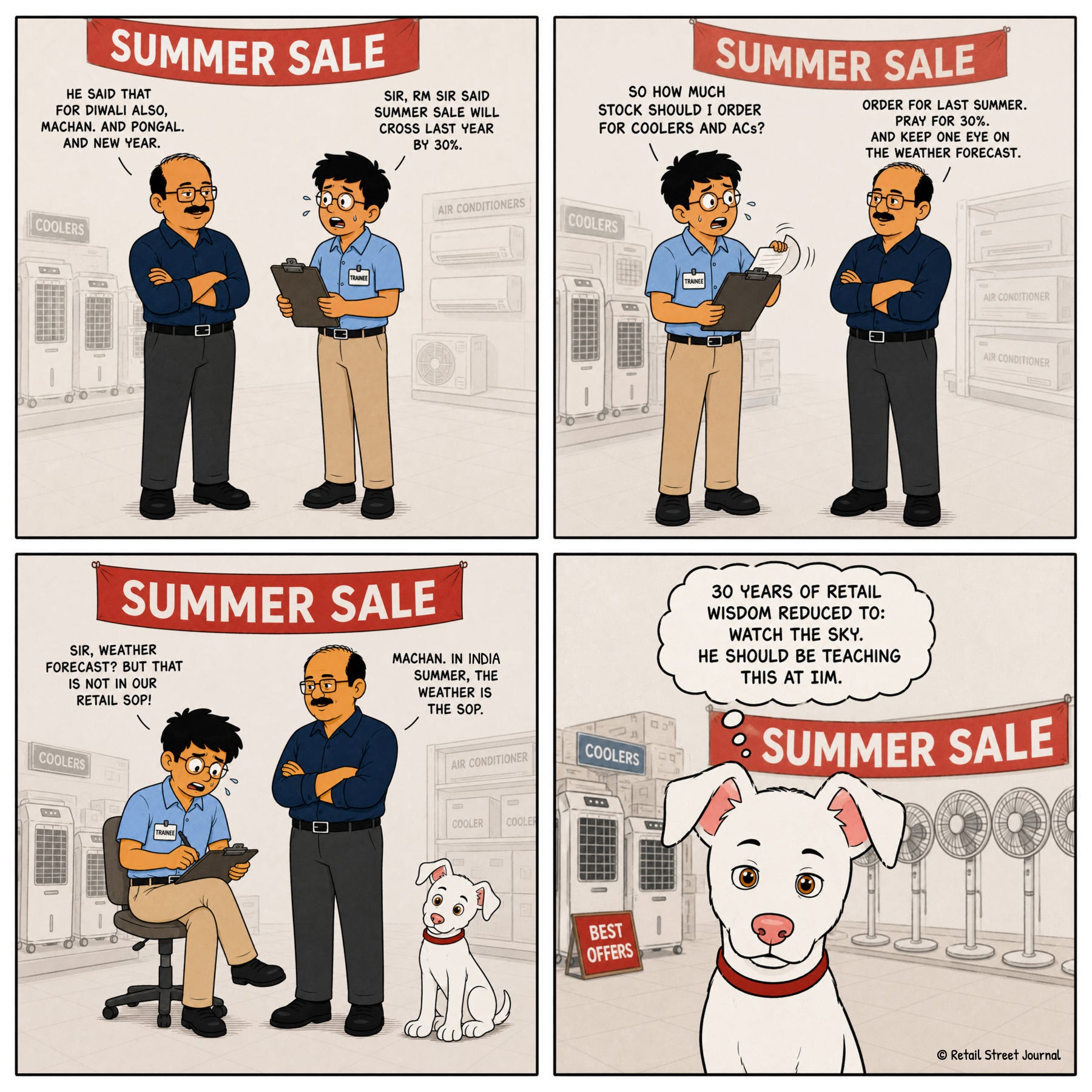
Note: In the original draft, Raja the Sage said “In Chennai summer, the weather is the SOP.” I changed it to “In India summer” because Chennai cannot single-handedly carry the heat narrative anymore. We are all suffering. Pan-India. Equally. Democratically.
Also: yes, the puppy is named Biscuit. Yes, the joke is intentional. Yes, the joke will continue. No, you cannot stop it. He is a Rajapalayam breed. He has more dignity than this entire industry.
If you enjoyed this — or if it triggered a flashback — more strips will be arriving every Monday and Thursday.
They will land in your inbox like an unsolicited audit notice, except funnier, and with a dog.
Subscribe. Or don’t. Biscuit doesn’t check the subscriber list. Biscuit doesn’t check anything. Biscuit transcends KPIs.
Silence is safer.
But raising your voice, whether anyone listens or not, is their problem, not mine.
Strip 02 lands Monday, from the back office, where the Ghost speaks for the first time. Bring tea.