

Audit Week
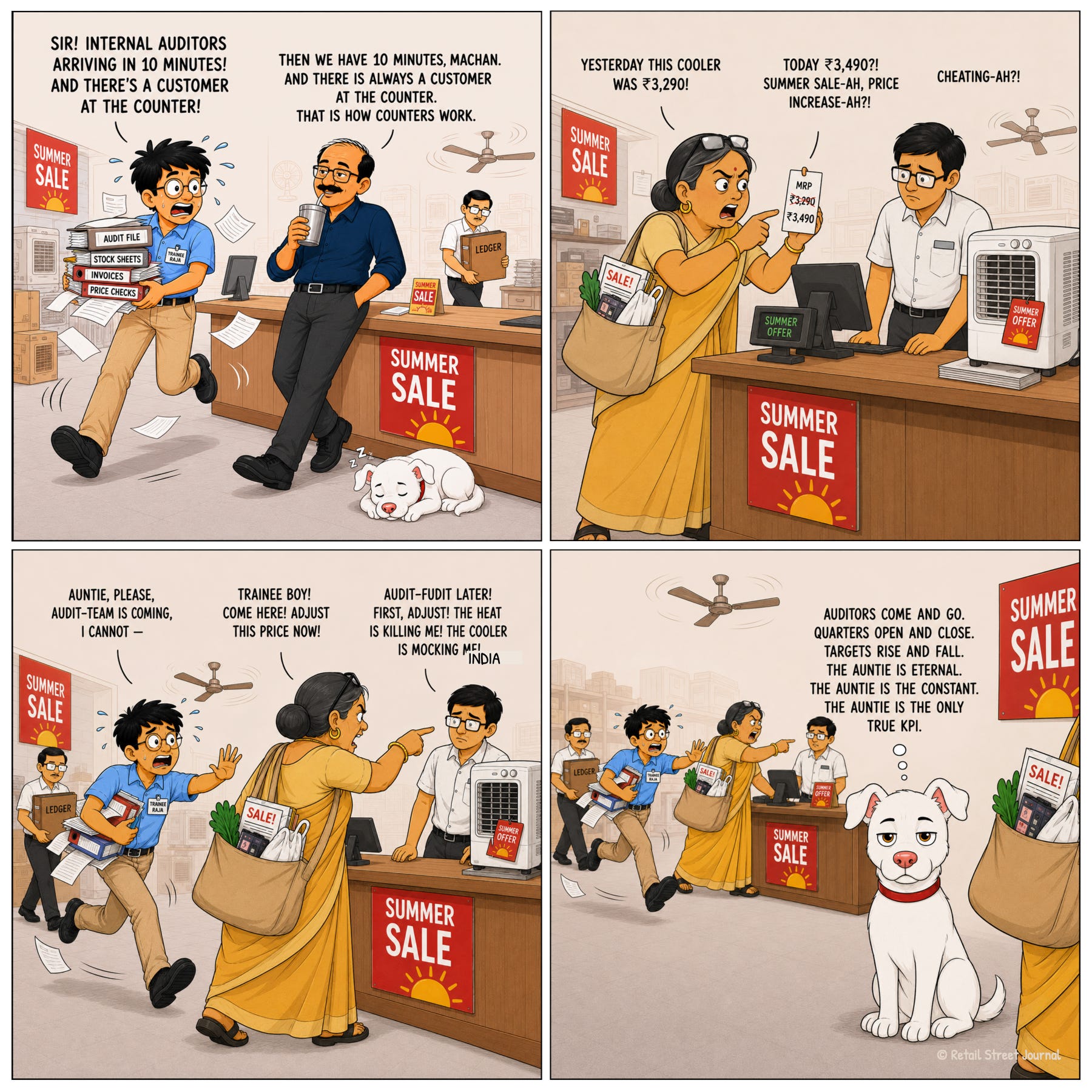
Or: how a ₹200 price change can survive a quarterly audit but not a determined Auntie.

It is the last week of May.
Which means somewhere in India, right now, two events are happening simultaneously in the same store.
In the back office, a team is preparing for internal audit. Files are being stacked. Stock counts are being reconciled. Three trainees are running between aisles holding clipboards that have started to look like evidence.
At the front of the store, a customer has just noticed the price increase on the offer product.
She is not happy.
She is, in fact, furious.
She would like to speak to someone about this.
The audit can wait.
I have witnessed approximately 500 of these scenes.
Possibly more.
The mid-sale price change is one of the most underdiscussed phenomena in retail. It happens constantly. It happens openly. It happens during the peak of every major sale season — summer, Diwali, year-end, Pongal, New Year clearance. And yet nobody in the industry talks about why it happens, because the answer is uncomfortable.
Let me, as a 30-year veteran, do the talking.
The Seven Real Reasons a Sale Price Changes Mid-Sale
1. The supplier actually raised the rate. This is the cleanest reason. A manufacturer increases their wholesale price mid-quarter. The retailer absorbs it for a week, then passes it on. Honest. Defensible. Boring. Happens maybe 20% of the time.
2. The first week sold too well. The retailer launches the sale at an aggressive opening price, sells out faster than expected, and quietly raises the price for the remaining stock. The hot units carry the margin loss. The next batch makes it back. This is called “price normalisation” in management circles. Customers know it by a different name.
3. The first week sold too badly. The opposite. The discount was too steep, didn’t convert, and now the store is sitting on inventory. The price goes down further. Sometimes additional discounts are stacked. Sometimes a “flash sale” banner appears suddenly on Wednesday afternoon. This is panic dressed as strategy.
4. The competitor blinked. A nearby store dropped their price. Yours has to match. Or yours raised theirs. Yours can quietly raise too. Either way, the change happens within 48 hours. No customer is told.
5. The MRP was “updated” by the supplier. This is a beautiful Indian retail phrase. Updated. The MRP printed on the box is now technically different from the MRP printed on the website is now technically different from the MRP displayed on the shelf tag. Three sources of truth. None of them aligned. The customer is invited to pick whichever causes the least argument.
6. Somebody made an error. The price was wrongly entered on day one. Marketing went out. Posters were printed. Customers walked in. Now the error has to be corrected, but quietly, so that the original poster is not technically a false advertisement. Lawyers may be involved. Posters may be reprinted at 11 PM.
7. The store is testing. This is the most controversial reason. Some retailers run deliberate price experiments during sale weeks — moving the price up by ₹200 to see if conversion holds. If it holds, the new price stays. If it doesn’t, they drop back the next morning and pretend it was a system glitch. Customers who notice are usually quietly given the lower price. Customers who don’t notice fund next quarter’s marketing budget.
Now — here is the part nobody outside retail understands.
The customer always notices.
Always.
It does not matter if the change is ₹200 on a ₹3,490 cooler. It does not matter if the change is ₹15 on a packet of biscuits. It does not matter if the customer is buying a refrigerator or a one-litre bottle of cooking oil.
The customer notices.
The customer remembers yesterday’s price.
The customer has photographic recall of MRPs in a way that should be studied by neuroscientists.
A senior retail leader once told me: “In India, the average shopper can quote the price of milk across four neighbourhood stores, but cannot remember her own anniversary.” This is not a criticism. It is a strength. It is the only reason Indian retail has any pricing discipline at all.
If customers didn’t notice, every retailer in this country would change prices three times a day.
This is why “audit week” is such a dramatic moment.
The audit team is checking internal compliance, stock counts, GST filings, vendor reconciliations, system logs.
But at the front of the store, there is an informal audit happening every single hour, conducted by customers with sharper memory than any auditor with sharper questions than any accountant. They are not paid. They have no uniform. They wear chappals and carry jholas.
They are not interested in your variance report.
They are interested in the ₹200.
And they will not move from the counter until the ₹200 is explained.
The store team has to manage both audits simultaneously.
The internal one is solvable. You can reconcile files. You can present variances. You can quote SOPs.
The customer audit is not solvable. It can only be survived. You apologise. You offer a small adjustment. You explain that the sale price “varies daily based on stock availability.” You suggest that yesterday’s price was “a special early-bird offer.” You produce a manager. You produce buttermilk. You produce excuses.
By the end of the conversation, the customer either:
Walks out triumphant with a ₹200 discount
Walks out triumphant with the original price restored
Walks out triumphant having extracted a free carry bag and a small bottle of water
Returns next Tuesday to do this again
The customer always walks out triumphant. This is non-negotiable.
There is one more truth.
The audit team does not know it, but their real audit is being conducted by the customer at the counter. The customer is the actual auditor. The customer is the real KPI.
The internal audit may discover ₹47,000 in unreconciled credit notes. This will result in a sternly worded email.
The customer at the counter may discover ₹200 in unexplained price increase. This will result in a Google review. A WhatsApp message to her sister-in-law. A note to remember next time she walks past your competitor.
One audit costs you a meeting.
The other audit costs you a customer for life.
Which one would you rather pass?
This, friends, is why retail veterans look slightly tired during sale weeks. We are not afraid of the auditors. We have managed auditors since 1993.
We are afraid of her.
Note: The seven reasons are real. I have personally been part of decisions for at least four of them. I will not specify which four. Possibly five.
Also: the “MRP updated by supplier” defence has now been deployed in Indian retail for so long that it has acquired the status of a folk tradition. There are entire HR onboarding sessions where new trainees are quietly taught the correct intonation. The intonation is important. Too apologetic, and the customer escalates. Too confident, and the customer escalates harder. The sweet spot is “weary regret” — as if you, too, were victimised by the supplier.
If this triggered a memory of a customer who would not move from your counter — you are not alone. Every retail leader has met her. She is not one person. She is a category. She has saved more pricing discipline in this country than any consultant.
Strip 06 lands Monday. The vendor meeting. Where every commitment is final, until it isn’t.
Bring tea. Bring buttermilk. Bring backup.