


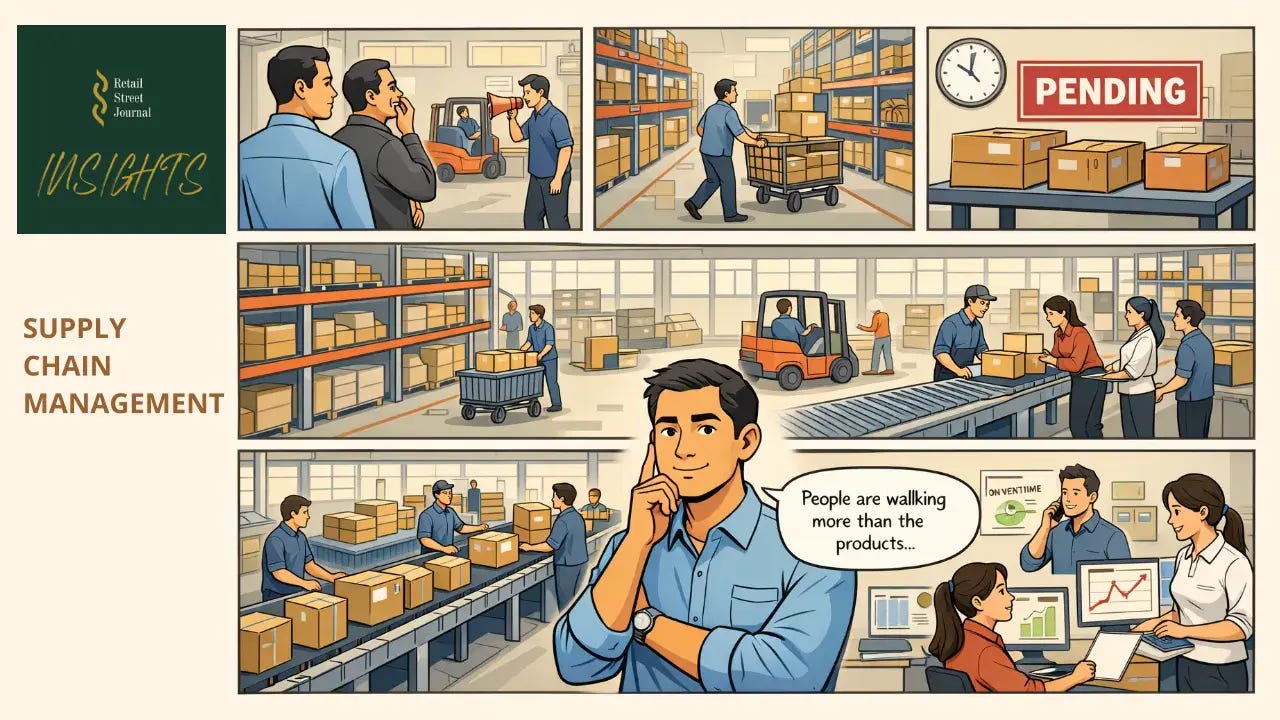
A few months ago, I was standing inside a large distribution warehouse at 7:15 in the morning.
On paper, everything looked perfect.
Demand forecasts were approved. Sales targets were aggressive but realistic. The ERP dashboard showed healthy inventory levels.
Yet on the shop floor, something felt… tense.
Supervisors were shouting order numbers. Pickers were walking long distances with trolleys. Forklifts crossed paths too often for comfort. By 9:30 AM, dispatch was already running late.
The CEO looked at me and said quietly,
“We don’t know where the problem is. Everyone is working hard.”
That sentence stayed with me.
Following the Order, Not the Report
Instead of opening a presentation, I asked for one thing:
“Let’s follow a single customer order — from system to truck.”
What followed was revealing.
The order was released on time. Inventory was available. The SKU locations were correct.
But the order waited.
It waited for a picker. It waited at a consolidation point. It waited for checking. It waited again for staging.
Nothing was technically wrong — but everything was slow because nothing flowed.
At one point, a supervisor said,
“Sir, people are walking more than the products.”
That was the moment the problem became clear.
When Movement Becomes the Bottleneck
In many warehouses we see, people move.
People walk to racks
People carry totes
People search, verify, re-check
Products remain passive.
As consultants at NestOne Group, we’ve learned something important:
The more humans move products, the less predictable the supply chain becomes.
Human effort is valuable. Human movement, at scale, is expensive.
That is where the conversation shifted — not to automation, but to flow.
The First Conveyor Was Not About Speed
When we proposed a conveyor-based system, the leadership assumed it was about faster picking.
It wasn’t.
It was about:
Reducing decision points
Removing cross-traffic
Making movement automatic, not optional
The first conveyor didn’t replace people. It replaced waiting.
Orders stopped queuing. Bins stopped piling up. Supervisors stopped firefighting.
For the first time, the warehouse felt calm — even though volumes hadn’t changed.
What Changed After Flow Was Introduced
A month later, I visited again.
No one was running. No one was shouting. The dashboard matched the floor reality.
Pickers stayed in zones. Products moved themselves. Exceptions were visible immediately.
One team leader told me,
“Now we know when something goes wrong — earlier, everything looked wrong.”
That is the hidden power of conveyor-based warehouses: they make problems visible early, not late.
The Warehouse Started Talking to the Supply Chain
Something else happened quietly.
Procurement began receiving clearer signals. Sales stopped over-promising delivery dates. Finance noticed faster inventory turns.
Nothing changed upstream.
But once the warehouse started flowing, the entire supply chain started listening.
The Lesson I Took Back
Every consulting engagement teaches us something.
This one reminded me:
A warehouse is not a building. It is a conversation between demand and delivery.
When that conversation is manual, it is noisy. When it is flow-driven, it is disciplined.
Conveyors are not about machines. They are about respecting time — customer time, employee time, leadership time.
At NestOne Group, we don’t ask clients,
“Do you want automation?”
We ask,
“Do you want predictability at scale?”
Because when the warehouse flows, growth stops feeling stressful — and starts feeling intentional.